Enhance business performance with quality management trainings
Is your organization striving to improve operational efficiency, increase customer satisfaction, and drive overall performance? TÜV Rheinland’s quality management courses are designed to equip your team with the expertise required to implement and sustain effective integrated quality management systems (QMS). By mastering industry best practices and quality management principles, your organization can gain a significant competitive edge. In today’s dynamic business landscape, delivering consistent quality is critical to maintaining customer trust and market position. Without robust quality processes, organizations risk falling short of expectations—leading to dissatisfied clients, declining market share, and a tarnished brand image. Establishing a QMS is a proven way to manage these risks, but it demands the right knowledge and practical skills.
TÜV Rheinland offers comprehensive QMS courses tailored to meet the needs of modern organizations. Covering key standards and methodologies such as ISO 9001, Six Sigma, quality management internal auditor trainings etc., our expert-led courses empower your team to effectively implement quality frameworks.
TÜV Rheinland delivers hands-on trainings across essential topics, including:
Core principles, standards, and industry best practices across various management systems and technical domains.
Implementation and continual improvement of internationally recognized standards and regulatory frameworks.
Risk-based thinking, assessment methodologies, and performance optimization techniques. Audit methodologies, compliance management, and process improvement approaches. Operational excellence, governance frameworks, and sustainable business practices.
Our trainings have empowered thousands of professionals and organizations worldwide to strengthen operational performance, ensure regulatory compliance, drive innovation, and achieve long-term business excellence.
Key benefits of our trainings:
Gain a comprehensive understanding of globally recognized standards, frameworks, and best practices, and learn how to effectively implement them within your organization.
Enhance your ability to identify risks, optimize processes, and implement strategic improvements that strengthen performance and resilience.
Improve organizational maturity by adopting structured management systems, governance models, and industry-aligned methodologies.
Advance your professional credibility and career prospects by deepening your subject-matter expertise and earning globally recognized certifications.
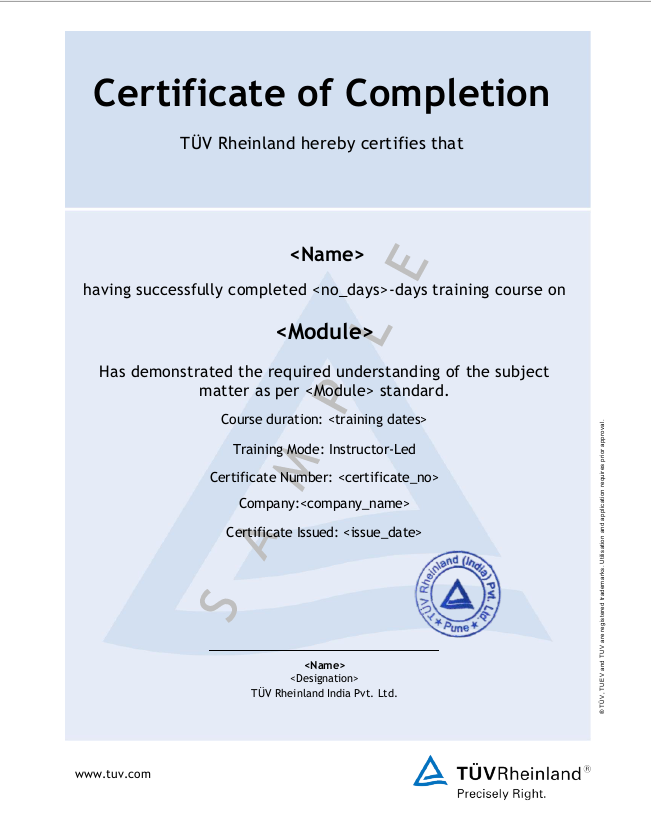
TÜV Rheinland Sample Certificate
TÜV Rheinland Sample Certificate
Key benefits of the training include:
Increased Operational Efficiency: Learn how to reduce waste, optimize processes, and drive measurable cost savings across your organization.
Higher Customer Satisfaction and Retention: Consistently deliver high-quality products and services that foster trust, satisfaction, and long-term loyalty.
Improved Internal Communication and Processes: Establish clear workflows and enhance cross-functional collaboration to support smoother operations.
Adherence to Regulatory Standards: Align with globally recognized standards like ISO 9001 Quality Management Systems, enabling access to new markets and business opportunities.
Stronger Competitive Advantage: Differentiate your organization with a certified and well-implemented QMS, earning greater confidence from clients, partners, and stakeholders.
Who should attend?
Quality assurance and quality control professionals
Reliability engineers and managers
Project managers, team leads, technical leads, project leads
Management students looking to deepen their knowledge of quality management principles
What is the duration of the quality management training courses?
The duration of our quality management training courses varies depending on the course content and level of depth. Typically, our courses range from one-day introductory sessions to multi-day in-depth workshops.
Are TÜV Rheinland's quality management online training courses certified?
Yes, our quality management training courses are certified and comply with industry standards. We continuously update our curriculum to ensure that it remains current and relevant in the rapidly evolving world of quality management.
How are TÜV Rheinland's quality management training courses delivered?
TÜV Rheinland offers a range of flexible delivery options for our quality management training courses, including in-person workshops, live online sessions, and self-paced e-learning modules. This enables you to choose the learning format that best suits your organization's schedule and preferences.
Can the training courses be customized to suit my organization's specific needs?
Absolutely! TÜV Rheinland offers customizable quality management training courses that can be tailored to address your organization's unique requirements, goals, and challenges. Our expert trainers will work closely with you to develop a bespoke training program that aligns with your specific needs.
What is the total quality management framework?
Understanding the framework of a quality management system (QMS) is crucial for organizations striving to improve their processes, products, and services. By implementing a total quality management tool that addresses these essential components, you can drive efficiency, reduce waste, and ensure consistent quality across your operations. The key elements of a quality management system include:
Leadership commitment and involvement
Customer focus
Process approach
Continual improvement
Fact-based decision making
Risk-based thinking
Employee engagement and competence
Documentation and record management
As you can see, implementing a robust quality management system is a multifaceted endeavor that requires a strong commitment from the entire organization. By focusing on these key elements, you can create a QMS framework that drives continuous improvement, enhances customer satisfaction, and supports your organization's growth and success. Remember, investing in quality management is not only about meeting industry standards but also about fostering a culture of excellence that sets your organization apart from the competition.
What is the role of continuous improvement in quality management?
Continuous improvement is a cornerstone of quality engineering and management, aiming to consistently enhance an organization's processes, products, and services over time. This ongoing effort involves identifying areas for improvement, implementing changes, monitoring results, and adjusting as needed. By embracing continuous improvement, organizations can drive efficiency, reduce waste, and ensure they remain competitive in the market.
Can TÜV Rheinland help my organization achieve ISO 9001 certification?
TÜV Rheinland provides training programs related to ISO 9001 requirements and quality management systems. Organizations may use this training to better understand the standard and support their internal implementation efforts. TÜV Rheinland also operates as an accredited certification body and can conduct certification audits in accordance with applicable accreditation rules.
How can I measure the effectiveness of my organization's quality management system?
Measuring the effectiveness of a quality management system involves tracking a variety of key performance indicators (KPIs) related to your organization's processes, products, and services. These KPIs may include customer satisfaction, on-time delivery, defect rates, process efficiency, and cost reduction, among others. By monitoring these metrics, you can identify areas for improvement and evaluate the success of your quality management initiatives.
Are there any pre-requisites for attending quality management trainings ?
No, there are no pre-requisites for quality management trainings and there are multiple foundation programs in the quality management category that can be attended by learners who wish to start from the basics for quality management.