Occupational Health and Safety Trainings by TÜV Rheinland India

Occupational Health and Safety Trainings

Prioritize safety. Minimize risks. Ensure compliance.

Workplace accidents, unsafe conditions, and unmanaged health risks can significantly affect employee well-being, productivity, and overall business continuity. Beyond the human impact, such incidents may lead to financial losses, reputational damage, operational downtime, and regulatory penalties. To effectively protect your workforce and align with globally recognized standards such as ISO 45001, organizations must adopt a structured and proactive approach to occupational health and safety management.

TÜV Rheinland’s occupational health and safety trainings are designed to equip professionals and organizations with the knowledge, tools, and practical skills required to implement, manage, audit, and continually improve robust safety management systems. Our comprehensive programs cover risk identification, hazard control, compliance requirements, leadership responsibilities, incident investigation, and performance monitoring — enabling organizations to move from reactive safety management to a culture of prevention and continuous improvement.

Through our expert-led sessions, participants gain actionable insights into establishing effective safety policies, integrating risk-based thinking into daily operations, and aligning safety objectives with broader business goals. Our courses combine global best practices, real-world case studies, practical exercises, and interactive learning modules to ensure that knowledge gained can be immediately applied in the workplace.

Contact

TÜV Rheinland India
27/B, 2nd Cross Rd
560100
Bangalore

TÜV Rheinland delivers hands-on trainings across essential topics, including:

  • Core principles, standards, and industry best practices across various management systems and technical domains.
  • Implementation and continual improvement of internationally recognized standards and regulatory frameworks.
  • Risk-based thinking, assessment methodologies, and performance optimization techniques.
    Audit methodologies, compliance management, and process improvement approaches.
    Operational excellence, governance frameworks, and sustainable business practices.


Our trainings have empowered thousands of professionals and organizations worldwide to strengthen operational performance, ensure regulatory compliance, drive innovation, and achieve long-term business excellence.

Key benefits of our trainings:

  • Gain a comprehensive understanding of globally recognized standards, frameworks, and best practices, and learn how to effectively implement them within your organization.
  • Enhance your ability to identify risks, optimize processes, and implement strategic improvements that strengthen performance and resilience.
  • Improve organizational maturity by adopting structured management systems, governance models, and industry-aligned methodologies.
  • Advance your professional credibility and career prospects by deepening your subject-matter expertise and earning globally recognized certifications.

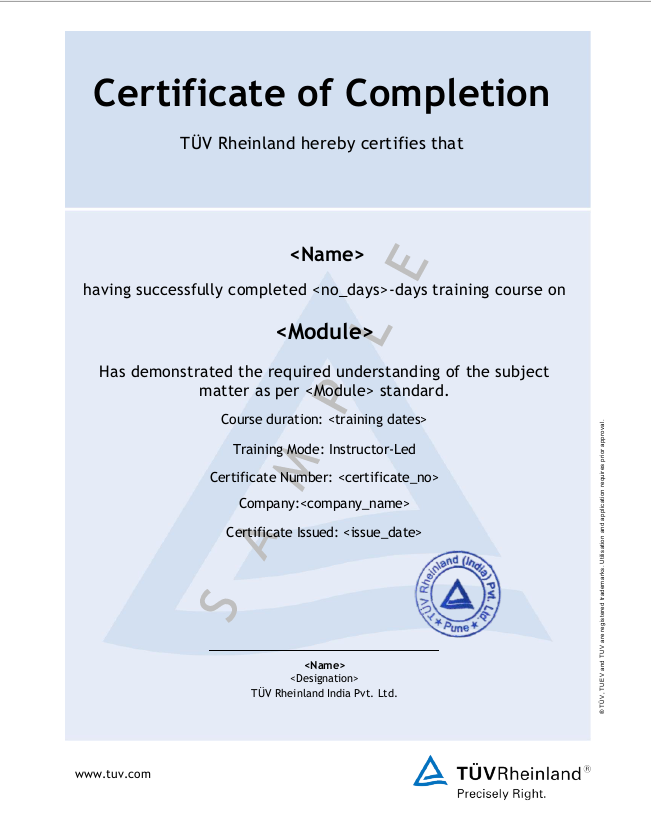
TÜV Rheinland Sample Certificate 

Sample TÜV Rheinland training certificate with official seal issued after successful completion of the courseSample TÜV Rheinland training certificate with official seal issued after successful completion of the course
TÜV Rheinland Sample Certificate

Who should attend?

  • Health and safety professionals
  • Facility managers, HR personnel, and operations managers
  • Safety officers, supervisors, and team leaders
  • Compliance officers, auditors, and consultants
  • Business owners and senior executives

Popular trainings


Enroll in TÜV Rheinland's occupational health and safety training today and secure the well-being of your workforce and the success of your organization.

Take the first step towards creating a safer workplace and a thriving organizational culture.

Find trainings

Frequently Asked Questions (FAQ)

  • What is occupational health and safety (OHS)?

    Occupational health and safety (OHS) refers to the policies, procedures, and practices designed to prevent workplace hazards and ensure the safety and well-being of employees, contractors, and visitors within an organization.
  • Why is occupational health and safety training important ?

    OHS training is vital for raising awareness of workplace risks, educating staff on preventive measures, and ensuring compliance with health and safety regulations. It plays a key role in reducing accidents, enhancing employee well-being, and improving overall organizational efficiency.
  • What does ISO 45001 implementation training involve?

    ISO 45001 implementation training equips participants with the expertise needed to establish, implement, and maintain a compliant Occupational Health and Safety Management System (OHSMS). Key areas include risk assessment, hazard identification, emergency preparedness, and incident management.
  • How does occupational health and safety training benefit the workplace?

    This training fosters a proactive safety culture by empowering employees and management to identify, assess, and mitigate risks. It contributes to fewer incidents, improved health outcomes, enhanced morale, and stronger regulatory compliance.
  • What is an Occupational Health and Safety Management System (OHSMS)?

    An OHSMS is a systematic framework that enables organizations to manage workplace health and safety effectively. It involves setting policies, conducting risk assessments, implementing controls, and ensuring compliance with standards like ISO 45001 to promote a safe working environment.
  • What are the key components of OHS management training?

    OHS management training typically covers:
    • Risk assessment and control measures
    • Hazard identification and reporting
    • Incident investigation techniques
    • Emergency response planning
    • ISO 45001 standard implementation and compliance strategies
  • How does an OHSMS improve workplace safety?

    An OHSMS enhances workplace safety by introducing a structured and repeatable process for identifying and controlling risks. It ensures alignment with legal and regulatory requirements and encourages a culture of continuous improvement in safety practices.
  • How can I apply OHS training knowledge within my organization?

    Post-training, you can apply your skills to strengthen your organization's safety protocols—such as developing or refining OHS policies, conducting regular risk assessments, leading incident investigations, and supporting the implementation of ISO 45001-compliant systems.

3 Items

  1. IMS Internal Auditor Training & Certification course based on ISO 9001, ISO 45001 & ISO 14001

    IMS Internal Auditor Training & Certification Course | Integrated Management System (ISO 9001, ISO 14001 & ISO 45001)

  2. ISO 45001 Internal Auditor Training & Certification course on Occupational Health & Safety Management System

    Professional program to build capability in planning and executing OHSMS audits
  3. Dangerous good safety professional ( DGSP - Global regulations )

    Enhance compliance, governance, and safety assurance through DGSP certification
per page